
How PMCS Delivers Government-Grade Accessibility Through the PAAM Framework
PMCSservices.com | DIR Cooperative Contract | IAAP Certified | 19+ Years Texas Public Sector
From Checkbox to Compliance: What We Learned on the Ground
Most organizations approach ADA and WCAG compliance the same way they run an automated scan, generate a report, and file it away. After 19 years of serving Texas state agencies under the DIR Cooperative Contract, PMCS Services knows what that approach misses.
Real accessibility compliance is not a report. It is a structured, repeatable process that combines automated tooling, certified expert evaluation, prioritized remediation, and ongoing sustainment. We built the PMCS Accessibility Assurance Method (PAAM) because the engagements demanded it.
This guide reflects what we have learned executing ADA compliance programs for Texas public sector agencies at scale: what the law requires in 2026, where organizations fail, and how a disciplined methodology changes outcomes.
What the Law Requires in 2026
ADA compliance for digital platforms is no longer a gray area. In April 2024, the U.S. Department of Justice finalized its Title II rule, establishing WCAG 2.1 Level AA as the binding technical standard for all state and local government websites and mobile applications. Compliance deadlines fall in 2026 and 2027 depending on agency size.
| DOJ Title II Final Rule Now in Effect DOJ Final Rule (April 24, 2024): ADA Title II now requires WCAG 2.1 AA conformance for all state and local government digital platforms. Compliance Deadline in 2026: Agencies serving populations of 50,000 or more Compliance Deadline in 2027: Smaller agencies Reference: ada.gov/resources/2024-03-08-web-rule/ |
In Texas, public sector agencies operate under additional state-level obligations. TAC 206 and TAC 213 establish digital accessibility requirements for state agency websites and technology acquisitions. DIR-contracted vendors including PMCS are expected to deliver to these standards across all engagements.
WCAG 2.1 AA compliance also aligns with:
- Section 508 binding for federal agencies and their contractors
- European Accessibility Act (EAA) effective across EU member states since June 2025
- UK Equality Act covering public and commercial digital services
- Enterprise vendor compliance frameworks now standard in procurement RFPs across sectors
The regulatory picture is clear. What is less clear for most organizations is how to achieve and sustain conformance especially across complex, multi-platform digital environments.
WCAG 2.1 AA - The Standard Explained
WCAG (Web Content Accessibility Guidelines) is published by the World Wide Web Consortium (W3C) and is the globally recognized standard for digital accessibility. It addresses usability for people with visual, hearing, motor, and cognitive disabilities.
WCAG is built on four foundational principles digital content must be Perceivable, Operable, Understandable, and Robust. WCAG 2.1 AA represents the industry-standard compliance level: above the basic floor of Level A, and practically achievable unlike the aspirational Level AAA.
| Level | What It Means | Who Requires It |
| Level A | Basic requirements minimum floor | Not sufficient for legal defense |
| Level AA ✓ | Industry standard legally defensible | ADA Title II, Section 508, EAA, TAC 206/213 |
| Level AAA | Advanced rarely achievable at full-site scale | Specialized platforms aspirational |
Why Accessibility Cannot Wait
After years of accessibility work across Texas state agencies, we have seen the same pattern repeat: organizations delay, compliance debt compounds, and remediation costs multiply. Here is what is at stake.
Legal and Regulatory Risk
Accessibility litigation is accelerating in both federal courts and state administrative proceedings. Non-compliant agencies and vendors face OCR complaints, demand letters, consent decrees, and forced remediation timelines always more disruptive and expensive than planned programs. The 2026 Title II deadline removes the ambiguity that previously allowed inaction.
Enterprise Procurement
VPAT (Voluntary Product Accessibility Template) documentation is now a standard requirement in enterprise and government RFPs. PMCS has seen procurement processes disqualify vendors before the first technical review because VPAT documentation was absent or outdated. Compliance is a commercial prerequisite not just a legal one.
The Scale of the Opportunity
More than one billion people globally live with some form of disability. In Texas alone, the scale of state agency digital services portals, benefits applications, document libraries means that inaccessible platforms create real barriers for millions of residents. Accessible design also improves usability for aging users, mobile users, and lower-bandwidth environments. Accessibility and effective UX are the same investment.
AI Does Not Solve This Automatically
A growing misconception in the market is that AI tools will handle accessibility. AI can assist generating alt text, providing captions, enabling voice navigation. But AI-generated content requires validation, and AI-driven interfaces introduce new accessibility challenges. On the DIR engagement, we consistently found AI-generated components that failed keyboard navigation and ARIA requirements. AI is a tool within an accessibility program not a substitute for one.
What WCAG 2.1 AA Actually Requires
Based on our work across state agency portals, Drupal platforms, PDF libraries, and dynamic web applications, these are the five technical domains that consistently generate the highest-volume findings:
Visual Design
- Minimum 4.5:1 contrast ratio for normal text; 3:1 for large text
- Text must resize to 200% without loss of content or functionality
- Color alone cannot be the sole means of conveying information
Media and Non-Text Content
- All images require descriptive alt text or null alt text if purely decorative
- All video content requires synchronized captions
- Pre-recorded audio content requires transcripts
Navigation and Interaction
- All functionalities must be operable via keyboard no mouse dependency
- Visible focus indicators must be present at every interactive element
- Skip navigation, logical tab order, and accessible menus are required
Screen Reader Compatibility
- Semantic HTML with proper heading hierarchy (H1 > H2 > H3 no skipping)
- ARIA labels, roles, and live regions implemented correctly throughout
- Dynamic content changes must be announced to assistive technologies
Forms and Error Handling
- Every form field must have a clear, programmatically associated label
- Error messages must identify the specific field and describe the error
- Guidance for correcting errors must be available before submission
On the DIR ADA engagement, forms and PDFs consistently generated the largest share of critical findings particularly in high-volume document libraries and multi-step government application workflows. These are also the areas where remediation has the greatest impact on real user experience.
How PMCS Delivers Compliance: The PAAM Framework
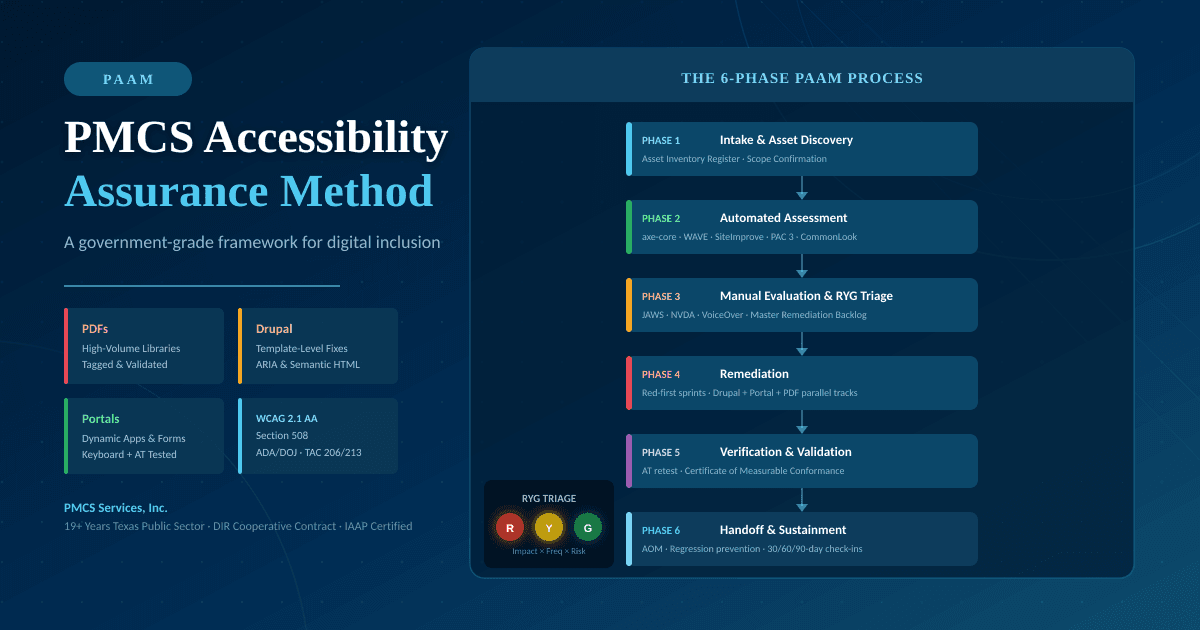
PAAM the PMCS Accessibility Assurance Method is the structured delivery methodology PMCS developed through its DIR Cooperative Contract accessibility engagements. It is a six-phase, government-grade framework designed to deliver measurable, defensible WCAG 2.1 AA conformance across complex multi-platform digital environments.
PAAM is not a theoretical framework. It was built and refined through hands-on remediation of state agency portals, high-volume PDF libraries, CMS platforms, and dynamic web applications the same asset types that create the most compliance risk and the most remediation complexity.
| PAAM at a Glance Standard: WCAG 2.1 AA | Section 508 | ADA/DOJ | TAC 206/213 Certifications: IAAP Certified | DIR Cooperative Contract Asset Coverage: Web Portals | CMS | PDFs | Dynamic Apps & Forms Experience: 19+ Years Texas Public Sector |
The 6-Phase PAAM Process
| Phase | Title | Key Activities & Tools |
| Phase 1 | Intake & Asset Discovery | Asset Inventory Register · Scope Confirmation · Platform mapping |
| Phase 2 | Automated Assessment | axe-core · WAVE · SiteImprove · PAC 3 · CommonLook · Lighthouse |
| Phase 3 | Manual Evaluation & RYG Triage | JAWS · NVDA · VoiceOver · Master Remediation Backlog · Impact × Freq × Risk scoring |
| Phase 4 | Remediation | Red-first sprints · Drupal + Portal + PDF parallel tracks · Developer handoff |
| Phase 5 | Verification & Validation | AT retest · Certificate of Measurable Conformance · VPAT documentation |
| Phase 6 | Handoff & Sustainment | Accessibility Operations Manual (AOM) · Regression prevention · 30/60/90-day check-ins |
Phase 1: Intake & Asset Discovery
Every PAAM engagement begins with a complete digital asset inventory. On the DIR ADA project, this meant cataloguing state agency websites, internal portals, document repositories, and PDF libraries often running into the thousands of files. Scope clarity is not administrative overhead; it is risk control. Without a complete inventory, organizations remediate the wrong things and leave the highest-risk assets untouched.
Phase 1 produces an Asset Inventory Register that assigns ownership, platform type, user impact level, and compliance priority to every in-scope asset before any testing begins. Phase 2: Automated Assessment
Automated scanning with axe-core, WAVE, SiteImprove, Lighthouse, PAC 3, and CommonLook is deployed across the full asset inventory. Automated tools surface approximately 30–40% of WCAG issues efficiently and at scale. On the DIR engagement, automated assessment across large Drupal portals identified consistent patterns missing alt text, contrast failures, and unlabeled form fields that informed both the RYG triage and the remediation sprint structure.
Automated results feed directly into the Master Remediation Backlog, creating a traceable, auditable record of findings from day one. Phase 3: Manual Evaluation & RYG Triage
Manual evaluation by IAAP-certified specialists using JAWS, NVDA, and VoiceOver captures what automated tools cannot: focus management failures, ARIA misimplementation, reading order defects, dynamic content announcement gaps, and cognitive usability barriers. On state agency portals with complex multi-step workflows, manual evaluation consistently uncovered critical issues that automated scans passed entirely.
All findings automated and manual are triaged using PAAM's RYG (Red-Yellow-Green) model. Each issue is scored on three dimensions:
| RYG Triage Model 🔴 RED High Impact × High Frequency × High Risk → Immediate remediation sprint 🟡 YELLOW Moderate scoring across dimensions → Scheduled remediation 🟢 GREEN Low impact or edge-case occurrence → Monitored and logged Triage formula: Impact × Frequency × Risk = Priority Score |
RYG triage is the mechanism that makes large-scale remediation tractable. Rather than remediating hundreds of findings in arbitrary order, teams work highest-priority issues first where the combination of user impact, occurrence frequency, and legal risk is greatest. This is the methodology that allowed PMCS to deliver measurable conformance improvement within compressed government project timelines. Phase 4: Remediation
Remediation on the DIR ADA project ran on three parallel tracks simultaneously: Drupal template-level fixes (ARIA implementation, semantic HTML, keyboard navigation), portal and dynamic application remediation (form labels, error handling, focus management), and PDF remediation (tagging, reading order, heading structure, table accessibility using PAC 3 and CommonLook). Running parallel tracks compressed the overall delivery timeline without sacrificing coverage across asset types.
Remediation sprints are structured Red-first. The highest-RYG-scored issues typically the ones that block screen reader users from completing critical tasks are resolved in the first sprint. This means that even if the engagement timeline is compressed, the most impactful issues are addressed first. Phase 5: Verification & Validation
Every remediated issue undergoes assistive technology retest using the same tools as Phase 3. Verification is not self-reported it is independently confirmed by the specialist who conducted the original evaluation. Phase 5 produces a Certificate of Measurable Conformance documenting the scope, methodology, findings, remediations, and conformance level achieved.
This certificate, combined with updated VPAT documentation, is the deliverable that gives government agencies and enterprise procurement officers the legal and commercial defensibility they require. It is also the record that protects against OCR complaints and litigation. Phase 6: Handoff & Sustainment
Accessibility conformance degrades over time without active management. Content updates, platform changes, new feature releases, and CMS template modifications all introduce regression risk. PAAM's final phase is specifically designed to prevent the compliance drift that makes a one-time remediation engagement insufficient.
Phase 6 delivers an Accessibility Operations Manual (AOM) tailored to the client's internal teams covering standards references, testing procedures, escalation protocols, and governance guidelines. PMCS implements regression prevention monitoring and conducts structured 30/60/90-day check-ins post-handoff. On the DIR engagement, the 90-day check-in cycle caught multiple regression issues introduced by routine content updates before they became systemic.
Three Misconceptions That Create Compliance Risk
"An automated scan is sufficient"
Automated tools capture 30% to 40% of WCAG issues at best. On every PAAM engagement, manual evaluation using JAWS, NVDA, and VoiceOver uncovered critical findings particularly in dynamic interfaces, complex forms, and PDF documents that automated scans rated as passing. Automated scanning alone does not produce a defensible compliance record.
"Accessibility is only a public sector concern"
Enterprise technology vendors, SaaS providers, healthcare platforms, and financial services firms increasingly face accessibility requirements in procurement. VPAT documentation is now a standard RFP request across sectors. Private sector organizations that treat this as a government problem are accumulating compliance debt that will become a commercial liability.
"One remediation project solves the problem permanently"
Accessibility conformance is not a project it is a program. Content updates, platform upgrades, and new feature releases introduce regression risk continuously. PAAM's sustainment phase exists because PMCS has seen remediated platforms return to non-conformance within months of project close without structured governance and monitoring in place.
The Strategic Imperative
WCAG 2.1 AA compliance is no longer a forward-looking aspiration it is a present legal obligation, an enterprise procurement criterion, and a measurable quality standard for digital platforms. The 2026 DOJ Title II deadline, the European Accessibility Act, and accelerating enforcement across both public and private sectors have closed the window for inaction.
What separates organizations that achieve compliance from those that remain exposed is not intent it is methodology. PAAM gives enterprise digital teams and government agencies a structured, repeatable, government-tested delivery framework to achieve measurable conformance and sustain it.
The question for digital leaders in 2026 is not whether accessibility matters. It is whether your organization has the process, the expertise, and the governance to deliver it.
| PMCS Services Accessibility Capabilities ✓ Accessibility assessments automated and IAAP-certified manual evaluation ✓ PAAM-structured remediation web portals, CMS, PDFs, dynamic applications ✓ VPAT production and Certificate of Measurable Conformance ✓ Accessibility Operations Manual (AOM) and governance frameworks ✓ Sustainment monitoring regression prevention and 30/60/90-day check-ins ✓ DIR Cooperative Contract | IAAP Certified | 19+ Years Texas Public Sector PMCSservices.com/DBITS |
References