
Every week, there’s a new headline, “AI replaces 10,000 jobs,” or “ChatGPT can do your job better than you.” It’s enough to make anyone nervous. But before you start panicking and updating your resume, let’s slow down and actually look at what’s happening because the real story is far more interesting than a clickbait title.
This isn’t just a tech debate. It’s a question about identity, value, and the future of your career. So let’s break it down honestly.
What AI Is Actually Really Good At
Let’s give credit where it’s due. AI tools in 2026 are genuinely impressive. They can process mountains of data in seconds, write first drafts, generate code, summarize reports, translate languages, and spot patterns that would take a human analyst weeks to find.
In industries like logistics, finance, and customer service, AI has already automated tasks that used to be done by entire teams. That’s not spin, it’s a real shift that companies like Amazon, JPMorgan, and Google have been capitalising on for years.
But here’s where people get confused: being fast and data-driven does not mean being capable of everything.
What AI Still Can’t Do And Probably Won’t For a Long Time
AI is powerful, but it operates within boundaries. It doesn’t feel right. It doesn’t truly understand context the way a person who’s lived through something does. It can mimic empathy, but it cannot replace it.
Think about a nurse sitting with a scared patient before surgery. Or a manager reading the room during a tense team meeting. Or a designer who pushes back on a client’s bad idea because years of experience told them it wouldn’t land. These are deeply human moments rooted in emotional intelligence, lived experience, and moral judgment.
AI is exceptional at structured, well-defined problems. Humans are exceptional at messy, ambiguous, people-centred ones. These aren’t the same thing and your career needs you to know the difference.
The Jobs Being Disrupted And the Ones Being Created
JOBS AT RISK
Roles built on repetition are genuinely under threat. Data entry clerks, basic customer support agents, routine paralegals, and entry-level code reviewers are all seeing AI do their work faster and cheaper. If your job is primarily about information processing, the pressure is real.
JOBS BEING CREATED
But here’s what the “AI will take all jobs” crowd misses: every major technological wave in history, the printing press, electricity, the internet, destroyed some jobs and created others. AI is no different. Prompt engineers, AI trainers, ethics auditors, and human-AI workflow designers are roles that didn’t exist five years ago and are now in high demand.
The World Economic Forum estimates that AI will displace 85 million jobs but also create 97 million new ones. Net positive. The real challenge isn’t job count; it’s skill transition. And that transition starts with you.
The Real Winner: Human + AI Working Together
Here’s the honest answer to the headline question: neither side wins alone. The careers thriving right now aren’t the people who replaced themselves with AI, or those who rejected it entirely; they're the ones who figured out how to combine both.
A doctor using AI to scan 10,000 radiology images in an hour is not being replaced, they're being supercharged. A copywriter using AI to produce first drafts and then applying their voice, judgment, and brand instinct on top produces more work, faster, and better. A customer service team using AI for routine queries while human agents handle complex emotional situations. That's a smarter organisation and a more fulfilling job.
What This Means for Your Career, Practically
If you’re a professional wondering what to do next, here are three honest moves that will actually make a difference:
Learn to work with AI tools in your field. Not to replace your thinking, but to accelerate it. Resisting the urge to ignore them that’s the fastest way to fall behind.
Invest in skills AI can’t easily replicate: communication, leadership, critical thinking, creative problem solving, and emotional intelligence. These are your career moats.
Specialise deeper, not shallower. The most resilient professionals will be those with genuine expertise in a domain, who also know how to leverage AI to work at scale.
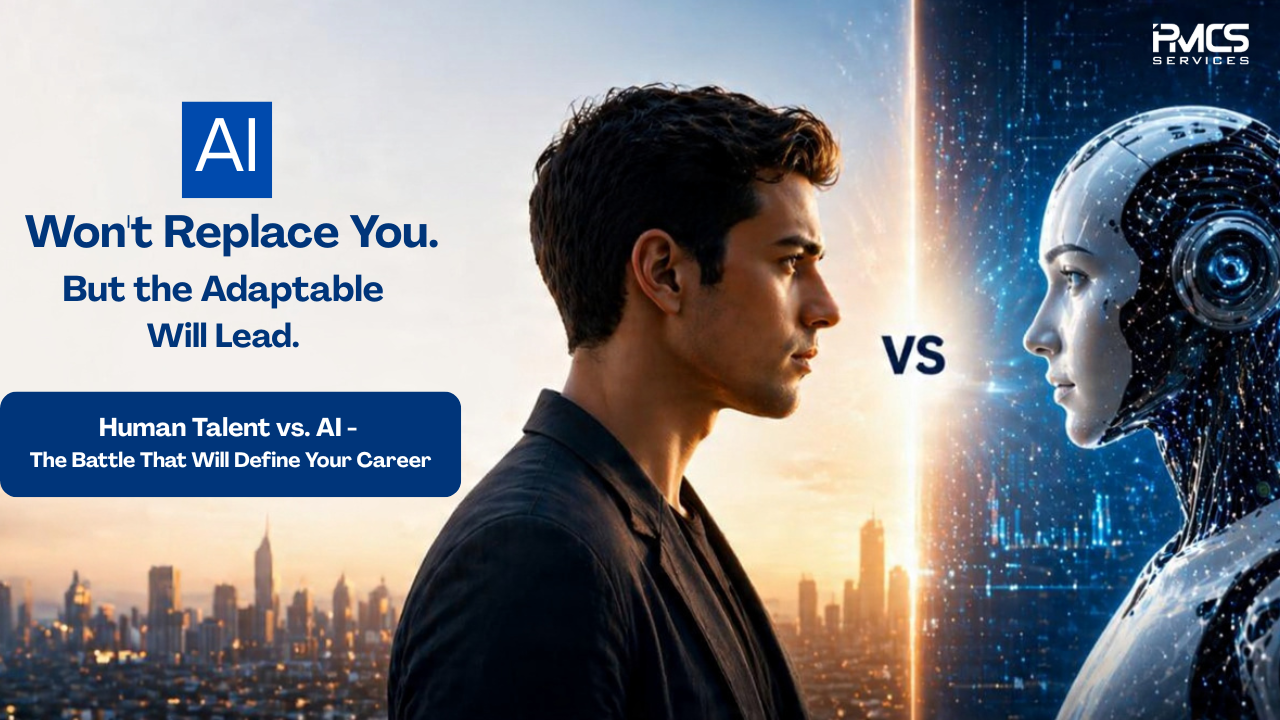
AI doesn’t have ambition, intuition, lived experience, or the ability to care about outcomes the way you do. That still matters enormously. The future of work isn’t humans vs. machines. It’s professionals who embrace AI vs. those who don’t.
The Humans Who Will Win Are Already Adapting
They're not waiting for permission or a company-mandated training. They're experimenting with AI tools on their own time, learning what works, and building instincts that no job description can teach. The professionals who will thrive in this decade aren't necessarily the most qualified on paper, they're the most adaptable in practice. They ask better questions, challenge assumptions, and use AI to amplify what they already do well. That's not a skill you learn in a course. It's a mindset you choose to develop starting now.
The battle for your career has already started. Which side are you on?
The professionals who struggle won't be the ones who couldn't learn AI, they'll be the ones who refused to. Every tool in history has separated those who embraced it from those who feared it. The printing press, the computer, the internet each created a new divide. AI is no different. The only question is which side of that divide you choose to stand on.
Ten years from now, two kinds of professionals will exist: those who shaped the AI era, and those who were shaped by it. The gap between them won’t be talent or luck. It will be one decision, made today: are you going to lead this change, or chase it?