
The Customer Service Experience That No Longer Works
Most customers still remember the frustration of traditional IVR systems.
They call a business, listen to a robotic menu, press multiple numbers, repeat information several times, wait on hold, and often end up speaking to the wrong department anyway. What was originally designed to improve customer service eventually became one of the most disliked parts of the customer experience.
That model is now becoming obsolete.
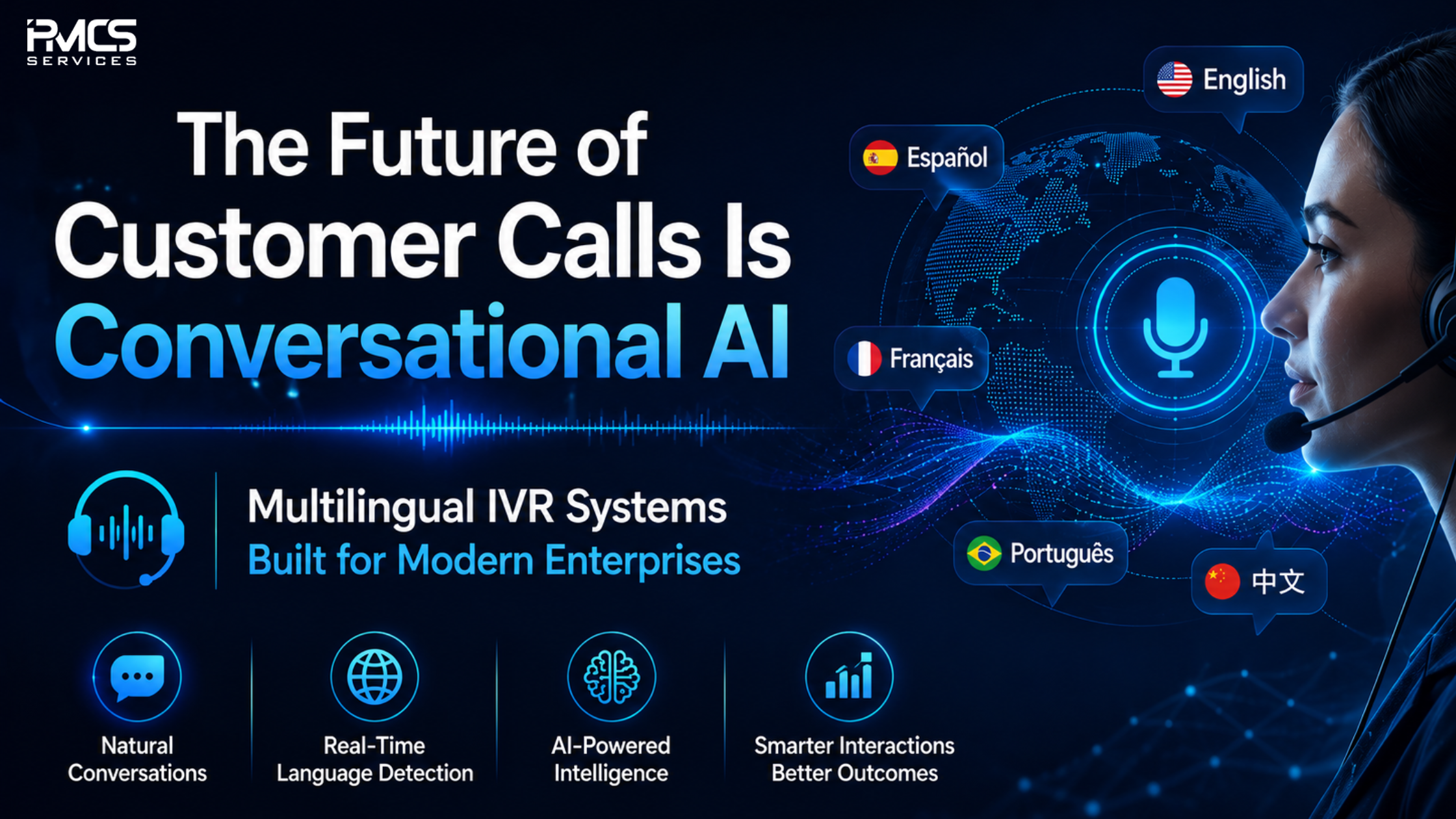
The new generation of IVR is fundamentally different from traditional touch-tone phone systems. Powered by artificial intelligence, natural language processing, multilingual speech recognition, and real-time CRM integration, these systems are transforming how businesses handle customer communication at scale.
Instead of forcing callers through rigid menus, modern AI-powered IVR systems understand natural speech, detect customer intent, communicate across multiple languages, and resolve issues conversationally.
At PMCS Services, we work with organizations modernizing customer engagement infrastructure through intelligent voice automation, multilingual support systems, and AI-powered customer interaction platforms designed for real operational environments.
This article explains why multilingual AI IVR systems are becoming essential in 2026, how the technology works, where businesses are seeing measurable impact, and what separates a strong deployment from a poor one.
Why Traditional IVR Systems Failed
Traditional IVR systems were built around menu trees.
Press 1 for billing.
Press 2 for support.
Press 3 for technical assistance.
That structure worked decades ago when customer interactions were simple and transactional. Modern customer service is no longer that predictable.
Customers speak naturally. They describe problems differently. They switch languages mid-conversation. They expect immediate answers instead of navigating endless menus.
Traditional IVRs were never designed for that level of conversational complexity.
Research surrounding modern IVR adoption shows that customers increasingly expect natural language interactions instead of button-driven systems.
The limitations became even more visible as organizations expanded globally and began serving multilingual customer populations. English-only systems created friction, longer handling times, repeat calls, and poor customer satisfaction.
The issue was not automation itself. The issue was outdated automation.
What Makes the New Generation of IVR “Different”
Modern IVR chatbots are built on conversational AI instead of static decision trees.
These systems combine several technologies simultaneously:
Natural Language Processing
Speech Recognition
Intent Detection
Sentiment Analysis
AI Voice Synthesis
CRM Integration
Real-Time Language Identification
Together, these technologies allow the system to understand what the caller actually means instead of forcing them into predefined menu paths.
A customer can say:
"I need to reschedule my appointment."
Another customer might say:
"I cannot make it tomorrow. Can I move my visit?"
The system understands both requests represent the same intent.
Modern AI voice systems can also maintain conversational context throughout the interaction instead of restarting workflows repeatedly.
This creates a dramatically smoother customer experience.
The Rise of Multilingual Customer Support
Multilingual support is no longer a luxury feature.
It is rapidly becoming a core operational requirement.
Businesses today serve customers across multiple regions, languages, and communication preferences. An English-only support model creates immediate barriers for large portions of the customer base.
Modern multilingual IVR systems solve this problem by automatically detecting spoken language and switching the interaction into the customer's preferred language in real time.
The caller no longer needs to navigate language selection menus manually.
The AI listens, identifies the language being spoken, and responds conversationally in that language almost instantly.
Advanced systems now support dozens of languages and regional dialects simultaneously.
This matters because language is not only about translation. It is about comfort, clarity, trust, and emotional understanding during customer interactions.
Organizations implementing multilingual AI IVR systems are seeing measurable improvements in:
First-call resolution
Customer satisfaction
Average handling time
Customer retention
Operational scalability
Research across customer experience platforms consistently shows that customers strongly prefer support interactions in their native language.
How AI-Powered IVR Systems Actually Work
The architecture behind modern IVR systems is significantly more advanced than older phone automation platforms.
A typical AI-driven multilingual IVR workflow now includes:
Speech Recognition The system converts spoken language into machine-readable text in real time.
Natural Language Understanding AI models analyze sentence structure, context, keywords, and conversational intent to determine what the caller needs.
Intent Routing Instead of routing based on button selection, the AI routes the customer based on detected intent.
CRM and Backend Integration The IVR system connects directly with customer databases, ticketing systems, scheduling tools, payment platforms, and internal enterprise systems.
AI Voice Responses Modern AI voice systems generate natural conversational responses instead of robotic prerecorded prompts.
Sentiment Detection Advanced systems can identify frustration, urgency, confusion, or escalation risk based on tone and conversational behavior.
This combination allows businesses to automate high-volume interactions while maintaining a far more human customer experience.
Industries Seeing the Biggest Impact
Healthcare
Healthcare providers are using multilingual IVR systems for appointment scheduling, prescription reminders, patient intake workflows, and post-visit communication.
Multilingual support is particularly important in healthcare environments where communication accuracy directly affects patient outcomes.
Financial Services
Banks and financial institutions are deploying AI-powered IVR systems for account verification, payment processing, fraud alerts, and customer onboarding.
AI voice authentication and multilingual conversational support reduce friction while improving operational efficiency.
Retail and Ecommerce
Retail organizations use conversational IVR systems for:
Order tracking
Return processing
Shipping updates
Loyalty program support
Customer inquiries
AI-powered automation reduces call center volume while improving response speed.
Government and Public Services
Public-facing agencies increasingly require multilingual citizen support systems capable of handling high-volume interactions without increasing staffing pressure.
Modern IVR platforms help agencies scale communication workflows while improving accessibility across diverse populations.
Why Businesses Are Investing in AI Voice Infrastructure
The business case is becoming increasingly difficult to ignore.
AI-powered IVR systems help organizations:
Reduce operational costs
Improve customer satisfaction
Scale support capacity instantly
Operate 24/7
Reduce agent workload
Improve response consistency
Handle multilingual demand without proportional staffing increases
Modern systems also generate operational intelligence from every interaction.
Organizations can analyze:
Common customer intents
Escalation triggers
Language usage patterns
Call abandonment trends
Resolution performance
Customer sentiment
This creates visibility that traditional IVR systems never provided.
What Separates a Strong Deployment From a Weak One
Not every AI IVR deployment succeeds.
The difference usually comes down to implementation quality.
Weak deployments still rely heavily on scripted keyword matching and shallow workflows.
Strong deployments focus on:
Genuine Intent Recognition The system understands meaning, not just keywords.
Multilingual Accuracy The platform handles accents, dialects, and mixed-language conversations naturally.
CRM Integration The AI can retrieve customer history, tickets, appointments, or account information instantly.
Human Escalation Complex or emotional conversations transfer smoothly to human agents without forcing customers to repeat themselves.
Continuous Learning The AI improves continuously through monitoring, retraining, and operational feedback loops.
At PMCS Services AI Solutions, multilingual IVR modernization focuses on operational deployment realities instead of generic automation templates.
The Future of IVR Technology
The next evolution of IVR systems is already emerging.
Future platforms will increasingly include:
Emotion-aware conversational AI
Real-time multilingual translation
Hyper-personalized caller experiences
Predictive support interactions
Voice biometrics
Generative AI conversational workflows
AI-powered agent assistance
Large language models are already improving the ability of IVR systems to manage open-ended conversations naturally.
Businesses investing now are building infrastructure that can evolve alongside these rapidly advancing capabilities.
The traditional IVR era is ending.
Customers no longer tolerate rigid phone menus, repetitive workflows, or language barriers that slow down support interactions.
The new generation of AI-powered multilingual IVR chatbots delivers a completely different experience. These systems listen naturally, understand intent, communicate across languages, integrate directly with business systems, and scale customer service operations far beyond what traditional call centers could achieve.
Organizations that modernize customer communication infrastructure now will not simply reduce operational costs. They will create faster, smarter, and more accessible customer experiences that directly improve retention, satisfaction, and long-term growth.
At PMCS Services, we help organizations deploy intelligent multilingual voice systems designed for real operational environments across government, healthcare, enterprise, and customer service ecosystems.
References
PMCS Services. Artificial Intelligence Solutions and Multilingual IVR Services. https://pmcsservices.com/artificial-intelligence
TechRadar Pro. What Exactly Is an AI Voice Agent and Why It Matters in Enterprise Communication. 2026.
Reverie. The Future of IVR Systems: Trends and Technologies Shaping Customer Experience. 2025.
Unity Connect. The Power of Multilingual AI IVR in Modern Contact Center Operations. 2026.
TaskUs. Voice Support Services and Multilingual Customer Experience Operations.
Web research and academic publications on AI-powered IVR, conversational AI, and multilingual customer engagement systems.